According to Towards Zero Waste, in 2017, Singapore did reach about 7.7 million tonnes of waste, increasing seven-fold over the past 40 years. Facing this issue, the country has been working towards becoming a zero-waste nation by launching many programs. For instance, reducing the consumption of materials, reusing and recycling to give them a second lease of life, etc.
In today’s article, we would like to give you a detailed explanation of the Zero Waste policy, showing why it is favoured by not only Singapore but many other nations from continent to continent.
What is Zero Waste?
Zero Waste was first launched as a Singapore government policy. Now it also refers to the lifestyle of striving to use as little single-use plastics as possible, instead of using sustainable and reusable alternatives. In other words, it means that you send as little as possible to landfills and replace as much as possible daily things with green or eco-friendly products. These products can be reusable, hygiene, more sustainable, or plastic-free. This lifestyle will ultimately help to protect the environment, benefit communities, and support a circular economy.
Why is Zero Waste Important?
Singapore’s one and only landfill, Semakau Landfill, is predicted to run out of space by 2035. Moreover, the time needed to build a new waste-to-energy incineration plant is every 7 to 10 years, and is every 30 to 35 years for a new offshore landfill. This is unsustainable in land scarce Singapore. Therefore, zero waste is crucial for Singapore now. It will help to conserve, reduce pollution and waste costs, increase the lifespan of Semakau Landfill and incineration plants, as well as mitigate climate change.
In 2019, Singapore officially ran the Zero Waste Masterplan (ZWM), aiming to build a sustainable, resource-efficient, and climate-resilient nation. The program also targets to raise awareness of waste issues and articulate the government’s efforts to adopt a circular economy approach to sustainable waste and resource management. Accordingly, ZWM focuses on 3 waste streams that have high generation and low recycling rates: Food, E-waste and Packaging including plastics. The approaching methods are more responsible and holistic, including Sustainable Production, Sustainable Consumption and Sustainable Waste & Resource Management.
Zero Waste Principles
Zero waste principles include 3 main sections of society that represent specific stages of the waste streams. They are Producer Responsibility, Political Responsibility, and Community Responsibility.
Producers are the forepart, taking responsibility for product design and manufacturing. In this stage, products must have eco-design, resource efficiency, and “industry symbiosis” (the waste of a company may be valuable for another company). Community takes the backside for consumption and disposal. All consumers should favour green-labelled products while committing to reuse, recycle and even donate. In the middle, Political responsibility acts as a link between the Community and Producer. And its roles are enforcing new legislation to promote zero waste principles and enhancing environmental & human health.
Zero Waste Hierarchy
Zero waste hierarchy is an essential list of strategies and actions designed to strengthen the zero-waste system. This hierarchy is built based on the 3 R’s (reduce, reuse, recycle) to sort out a list of priorities ranging from best to worst usage of materials.
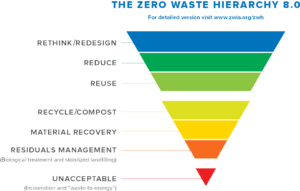
- Rethink/Redesign: Rethinking/redesigning products and materials aims to encourage more circular production and consumption. Specifically, consumers should use reusable, recyclable or sustainably gathered non-toxic materials. Manufacturers can use cyclical materials and have extended producer responsibility for the entire lifecycle of a product.
- Reduce: Reducing waste is to ensure more materials and products are kept within the loop for as long as possible. Therefore, it is advisable to make sustainable purchasing that supports social and environmental concerns, avoids disposal of products and reduces waste by minimising materials’ quantity and toxicity while planning for consumption habits.
- Reuse: Maximising reuse of materials and products is the overarching goal at both production and consumer levels. There are a variety of ways such as repair, refurbishment, modular technologies and replacements in alternative ways.
- Recycle/Compost: Recycling and composting are efficient ways to deal with waste. It is a way to support and expand existing systems that allow for high-quality recyclables and materials. Hence, there should be collection and processing of recyclables in local markets and decentralised composting at home.
- Material Recovery: Efficient material and energy recovery is significantly helpful to reduce fresh resources and discharge waste materials. This practice can be performed by separating mixed materials at the source and recovering materials from existing discard sites. Importantly, it should only be operated at biological temperatures and pressures for environment and health safety.
- Residual Management: This stage aims to minimise polluting gases and toxic residuals from materials. Therefore, it is encouraged to preserve resources and minimise destructive disposal methods.
- Unacceptable: This final stage is only proceeded if above stages are unable to conduct. It includes the incineration of materials and products for energy in particular, while also refusing any actions of the production/destruction of discards or recyclables.
Waste Management Solutions for Your Business
Zero Waste is a long journey. It requires the efforts of individuals, communities, organisations, businesses and the government, working closely together to achieve. To promote a sustainable Singapore, Synergix Technologies with 32+ years of experience in providing ERP software offers customisable and optimised solutions for SMEs. Synergix Waste Management Solution is the ultimate tool for you to deliver your operation efficiently with standard packages by industries and integrated modules such Contract Management, Project Costing Management, CRM, HRM, Financial Management, etc.
Should you have any concern, get in touch with our expert today for more information!