Accounts payable directly influences the cash flow, cost management and relations with the suppliers. Manual invoice management and disconnected tools also commonly cause delays, errors and restricted visibility as SMEs expand. Close to 39 percent of invoices have been found to have mistakes during manual processing, and the average days of processing invoices is usually over 8 days, which makes them less visible and increases cost to SMEs.
Businesses can manage the invoices more effectively with the help of accounts payable software solutions which facilitate better automation of approvals, enhance accuracy and facilitate a better overview. These solutions when provided by an ERP system will bridge the accounts payable to the broader finance operation which aids in achieving greater control as operations grow.
In this article, the author describes the mechanism of accounts payable software that is built on ERP and what SMEs need to take into account when exploring their supply.
Role of Accounts Payable Software Solutions for Growing SMEs
With the growth of SMEs, the accounts payable processes tend to become complicated. The number of invoice requests grows, the recipient chains become longer, and the finance departments should have a better picture of payments and debts. Once performed manually, some processes begin to slow operations and make them more prone to errors.
The automation software to address these issues is accounts payable programs, which brings about structure and consistency. Repetitive tasks are lowered by automation and invoices take the right review and approval procedures by defined work flows. This enhances management and minimizes losses of time.
Simple tools, such as spreadsheets, can prove enough in the initial development of many SMEs. With time, though, these techniques complicate the process of keeping things accurate and visible. It is at this stage that a more integrated accounts payable system will be required to facilitate the continued development.
Read more: Invoice Application Integration with ERP Software for SMEs
What Are ERP Accounts Payable Software Solutions?
Accounts payable software solutions are programs that facilitate the supplier invoices maintained in order to receive, approve, post and pay. These systems implement rules and automation to every action of the process instead of using manual data entry and email approvals.
An integrated accounts payable system has:
- Invoice receipt and storage: The invoices are received online in the format of PDFs, email attachments, or electronic invoices and kept in a central storage.
- Digital invoice data capture: Critical information is automatically selected and minimizes human input in the process of increasing precision.
- Workflows validation and approval: Two way or three way matching are used to verify invoices against purchase orders and goods receipt records where necessary. The finance teams can always see approval status.
- Entering into the accounting system: Approved invoices are recorded by set up accounting rules maintaining financial records.
- Scheduling and reporting of payments: Payments are scheduled according to agreed terms, while reports provide insight into outstanding and upcoming liabilities.
Integration is the distinction between a simple tool and a complete solution. Independent tools tend to handle an individual aspect of the process, potentially resulting in the redundant work and data leakages. ERP accounts payable systems are linked to invoice processing which is directly interrelated with the general ledger, supplier record and purchasing information. This model brings about a single business financial information source.
ERP-based accounts payable automation can reduce processing costs by up to 80% and cut invoice processing time by around 25%, helping finance teams work more efficiently.

What to Expect from ERP Accounts Payable Software Solutions
In evaluating accounts payable software solutions, SMEs should know what the system is supposed to provide as well as the implications of the system on the work that is done daily in the area of finance. Accounts payable is not the independent functionality in an ERP environment. It is a subset of an extended finance process.
From a system perspective, an ERP-based accounts payable solution should support:
- Central invoice handling: Invoices in common should be received and stored in system in digital format with all records being stored in a single location.
- Defined checks and approvals: Clear rules of validation and approval on the basis of value, supplier or department should be used in the invoices.
- Consistent accounting treatment: The data of the invoice must be posted to the appropriate general ledger accounts in accordance with standard rules according to the chart of accounts of the business.
- Direct system integration: Accounts payable is not supposed to manual transfer with supplier records, purchasing data, and financial reporting.
- Support for growth: The system must be able to support increased volumes of invoices and increase the number of users without any added tools.
In the case of SMEs, the following capabilities yield a practical result in day-to-day activities:
- Invoices pass approval more fast and predictable.
- The finance units can easily see the outstanding and future payments.
- There is less manual data input and follow-ups.
- There is reduced opportuneness in posting errors and duplicates.
- The accounts payable remains in line with the other finance operations.
ERP systems like those offered by Synergix Technologies combine all these aspects in a single system, and they assist SMEs to process accounts payable in a regulated, consistent manner, as their businesses grow.
Standalone Accounts Payable Software vs ERP-Integrated Solutions
Some SMEs begin with standalone accounts payable tools to solve specific problems, such as invoice capture or approvals. While these tools can help in the short term, they often sit outside the main finance system.
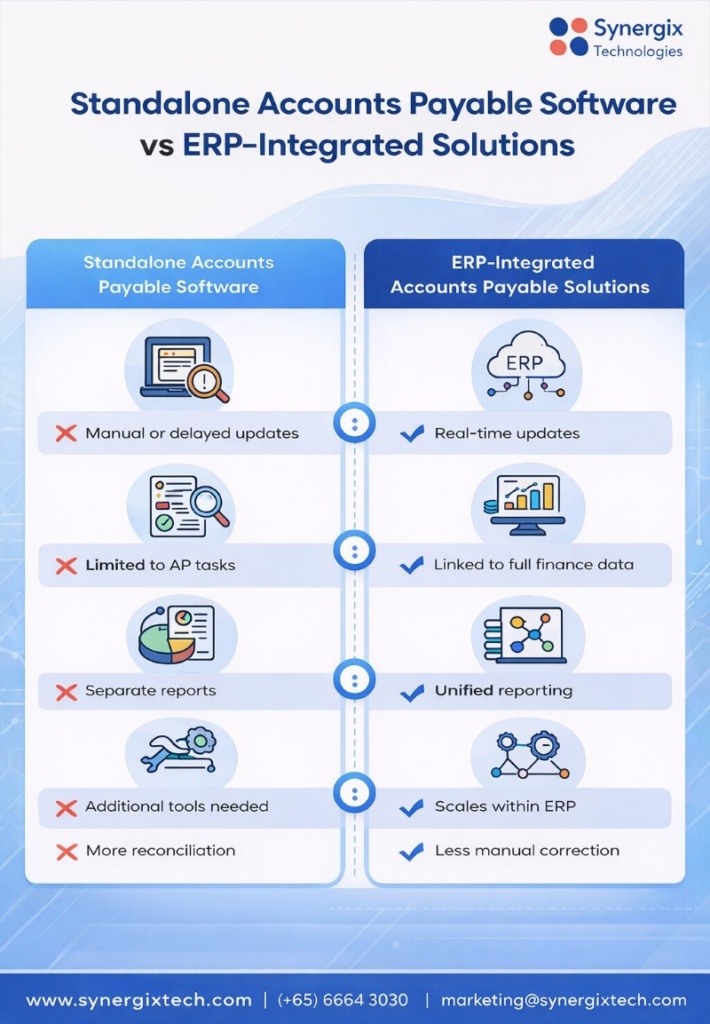
Over time, managing multiple systems increases workload and reduces clarity. ERP-integrated accounts payable avoids these issues by keeping all finance data in one place, which is often a better fit for SMEs planning to grow.
Read more: Everything about Invoice Billing Software for SMEs in [year]
In the case of SMEs, accounts payable software is the most valuable one when combined with an overall ERP plan. Aligning invoice processing with accounting, purchasing, and report facilitates better financial control with an increase in operations.
Accounts payable solutions using ERP enable finance teams to use common information and uniform rules on processes. This minimises the manual handovers and contributes to maintaining the records on hand without causing complexity.
Synergix Technologies has ERP solutions that offer integrated accounts payable to SMEs. Controlling accounts payable through the ERP environment will enable businesses to assist in the daily finance activities besides ensuring the financial information remains reliable.

Conclusion
Increasing the amount of transactions, accounts payable software solutions can assist SMEs to handle the purchase of invoices better. When the solutions are included in an ERP system, they enable more clarity of control, uniformity of processes and enhanced visibility of finance activity.
Key takeaways:
- Manual accounts payable systems are not scalable.
- The accounting-related invoice handling and purchasing are maintained by ERP-based accounts.
- Combined systems eliminate mistakes, time wastes, and redundant efforts.
- Good management of cash is achieved with a clear oversight of payables.
In the case of SMEs that have been considering their accounts payable procedures, an ERP approach is a sensible baseline to a solid improvement in the long run. To get to know more about integrated accounts payable in an ERP system that is designed to support SMEs, get a free demo to visit the solutions provided by Synergix Technologies.