
The production process is getting more data-driven. Plants in the contemporary world are based on automation that allows the control of the machines and preserves the production cycle. Meanwhile, the management teams require precise information regarding the operations to plan the production, inventory control, and costs of manufacturing.
A distributed control system (DCS) forms a core automation layer in many industrial environments. It monitors the equipment and controls production processes in various machines and control stations.
Nonetheless, there is a disconnect between business systems and the shop floor automation, which is usually present. The production systems produce huge amounts of process data, which are needed by enterprise platforms like ERP to be able to plan, manage inventory, and cost.
When ERP and distributed control systems work together, manufacturers gain stronger operational visibility. This blog explains what a distributed control system is, how ERP and DCS operate at different layers, why integration matters, and the practical benefits for manufacturers.
What Is a Distributed Control System?
A distributed control system is an industrial automation platform that monitors and controls production processes across multiple machines and control units. The system also does not depend on a central controller, but instead, the control tasks are distributed by a number of interrelated components.
Some of the important aspects are:
- Multi-controller decentralised control architecture.
- Live tracking of machines and production situations.
- Ongoing management of processes in a bid to ensure stability in operations.
Typical components include:
- Controllers and sensors
- Operator workstations
- Human Machine Interfaces (HMI)
- Designing configuration tools
- The industrial communication network
Chemicals, oil and gas, power generation, pharmaceuticals and food processing are some of the industries that are greatly dependent on DCS technology. The Global Distributed Control Systems Market is projected to expand from a valuation of USD 22.36 billion in 2025 to USD 33.09 billion by 2031, reflecting a Compound Annual Growth Rate (CAGR) of 6.75%.
The distributed control system focuses on process control and plant stability, rather than business planning or financial management.
ERP in Manufacturing Operations
Automation systems are applied in the production processes, but ERP is applied on the enterprise level. ERP systems are used to operate the basic business processes, which facilitate manufacturing operations.
These typically include:
- Production planning
- Inventory control
- Procurement
- Sales order management
- Financial accounting
ERP assists the management in responding to the important questions in operations, which include:
- Which products are to be manufactured?
- At which stage should production occur?
- What materials are required?
- How expensive is the cost of production?
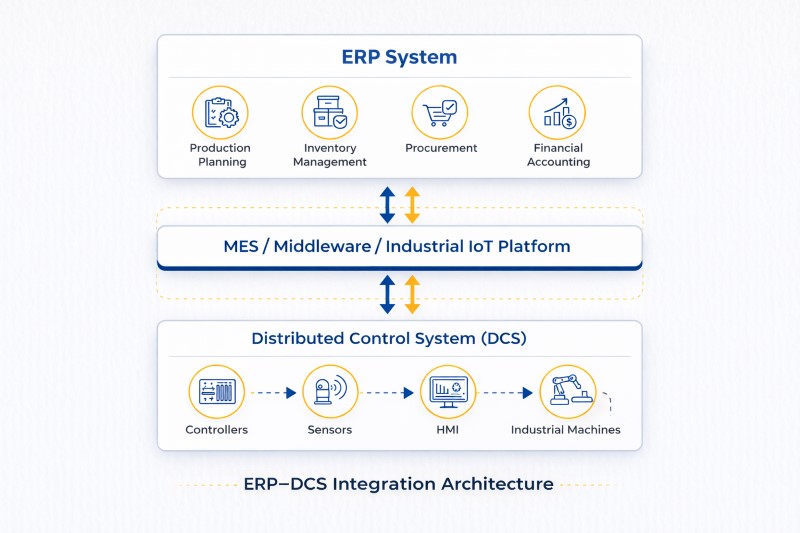
This position is unlike plant automation systems. ERP is aimed at business planning, resource coordination, and transactions. On the other hand, DCS platforms deal with machine control and automation on real time processes.
The connection between these two layers will provide the manufacturers with a better connexion between business decision making and operational activity.
Learn more: What Is an Enterprise Resource Planning ERP) System?
Why Integrating ERP with a Distributed Control System Matters
Unless the production data is integrated, useful production data usually stays on the shop floor. Process data can remain in control mechanisms, and the management will be based on late reports or manual updates. These disconnects may cause slow decision-making and information inaccuracies.
Connecting ERP with a distributed control system helps bridge this divide. Production visibility is real time, enabling the managers to view the output in real time as opposed to using summaries of the past. Real machine production can be fed into the ERP production records and enhance accuracy in reporting.
Inventory tracking is also enhanced by integration. Inventory will be automatically recorded as manufacturing occurs. Scheduling is then revised by planners using real plant performance as opposed to assumption.
Earlier visibility into production delays or quality problems can be corrected promptly. This leads manufacturers to have more control over operations and alignment of the performance in the shop floor with the business planning.
Learn more: Synergix Manufacturing ERP Software

Typical Data Flow Between ERP and DCS
Two-way communication is essential to integrate the ERP and the plant automation effectively. Every system communicates with the others in terms of the type of information that it exchanges, depending on the role that it plays in the manufacturing environment.
ERP to DCS
ERP systems normally provide operational instructions to the control layer that include:
- Production orders
- Batch parameters
- Product recipes or manufacturing specifications
These are instructions that facilitate the production activities on the shop floor.
DCS to ERP
The control system, in its turn, gives feedback on its operations, such as:
- Production quantities
- Process status updates
- Equipment utilisation
- Material consumption data
Most manufacturing systems have a middleware platform or Manufacturing Execution System between the two layers. The most common technologies that are employed in this connection are the OPC communication standards, Industrial IoT platforms, and MES solutions.
It is necessary to mention that ERP is not a substitute for DCS. There are various systems, the purpose of which is different in the manufacturing architecture.
ERP-DCS Integration Business Advantages
A combination between ERP and the plant control systems has definite operational benefits to the manufacturers.
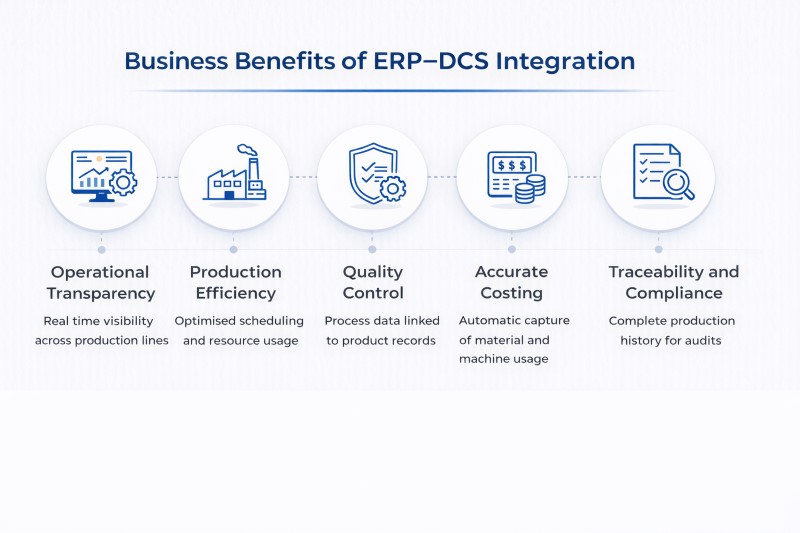
- Enhanced operational transparency: The management has a clearer view of the production lines and facilities.
- Increased efficiency of production: Real time production information assists the planners to optimise schedules and allocate resources better.
- Improved quality control: Process information can be linked to the production records, which will make it easier to identify quality issues faster.
- Proper costing: Consumption of materials and use of equipment could be automatically taken to improve the cost analysis.
Greater compliance and traceability: It is simpler to comply with audits and regulatory requirements because it is simpler to track the production history (e.g., ISO, GDPR, FDA).
The broader digital manufacturing programmes are also backed up with integrated systems. Organisations can process production data more effectively, and faster adjustments can be made with regard to operations.
Implementation Considerations for Manufacturers
Companies that want to integrate an ERP system plus plant automation should beware of the process.
- System compatibility: Basically, it is important to ensure that the control system and the ERP platform can work with compatible communication protocols.
- Data structure alignment: Production data should be structured in a similar way as the master data used in ERP to ensure similar reporting.
- Cybersecurity: There should be secure communication between the operational technology and the IT systems.
- Phased implementation: Most companies can start with a limited number of production lines and then scale out through the plant.
- Change management: There should be proper training of operations teams and IT staff to handle integrated workflows.
ERP systems built to work in a manufacturing context can make this integration process easier and facilitate easier adoption.

Conclusion: Connecting the Shop Floor to Business Strategy
Contemporary manufacturers need reliable business visibility as well as process control. A distributed control system maintains stable and safe production processes on the shop floor, while ERP systems manage planning, inventory, and financial oversight.
With such systems combined, the business acquires real time production insights, improved reporting and enhanced decision making features. The relationship between the enterprise systems and the operational technology develops as an important aspect of digital manufacturing strategy.
Manufacturers considering digital transformation can review the connections of their automation platforms with business systems. ERP systems like Synergix ERP have the capacity to combine data on operations into a single environment, which will assist in improving coordination in the production, inventory, and finance processes.