Whether you are an operations manager, business owner, or a finance professional, it is imperative that you learn about procurement in order to operate a cost-effective and compliant business. Procurement is not simply about buying things. It is a strategic activity that can or break your bottom line.
This guide will teach you the meaning of procurement, how procurement works in practice, the various types of procurement that your business employs and how modern ERP systems can enable your SME to take procurement out of the manual headache into a streamlined competitive advantage.
What Is Procurement? (Definition & Business Meaning)
The whole process of obtaining goods and services required by a business to operate is known as procurement. It involves the process of determining what you require, identification and assessment of suppliers, bargaining the terms, preparing the purchase orders, receipt of goods, invoicing and oversee relationships over time with your suppliers.
Procurement vs Purchasing: What’s the Difference?
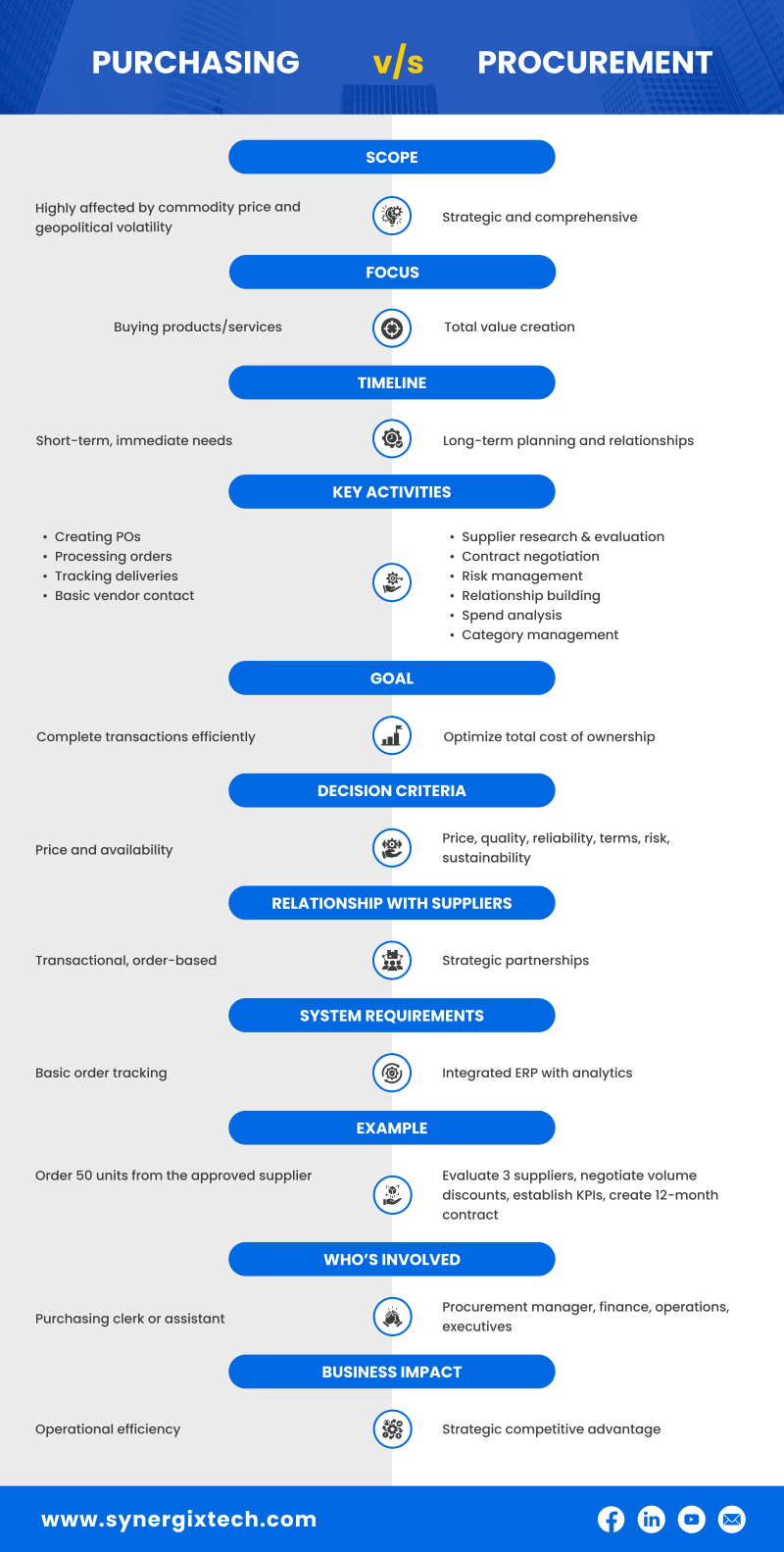
There is a lot of confusion between these terms though they are not interchangeable:
Procurement is a strategic and end to end process involving research of suppliers, contract negotiation, relationship management, quality evaluation and long term planning. It has to do with acquiring the right products at the right price in the right suppliers.
Purchasing involves the tactical act of acquiring an item. It is a single step of the larger procurement procedure, which is aimed at making purchase orders and finalising transactions.
Strategic vs Operational Procurement
Strategic procurement concentrates on creating long term value by partnership with the supplier, contract optimisation, risk management and category approach. It helps to answer such questions as: Who are our suppliers that we have to build relationships with? What can we do to decrease total cost of ownership?
Operation procurement takes care of its day to day transactions and activities. It monitors the correct issuance of purchase orders; receiving of goods at the right time and paying of invoices in the right way.
Both are necessary yet it is strategic procurement that will make the difference between the businesses that survive and business flourish.
Why Procurement Is Critical for SMEs
For small and medium enterprises, effective procurement directly impacts profitability and growth. Here’s why it matters:
- Cost Control: According to McKinsey & Company , procurement takes 50-80 percent of the cost base of a company, and is one of the biggest areas of cost optimisation. Even minor increases in procurement efficiency can result in major margin increases.
- Supplier Reliability: Your business is subjected to suppliers who supply at the right time and with the right quality. Bad procurement operations result into stockouts, delayed production and dissatisfied customers.
- Cash Flow Management: When procurement is not handled effectively, you can have inventory that is not selling, or you will have expediency orders that are more expensive. The smart procurement maintains efficient flow of working capital.
- Compliance and Audit Readiness: Your business is safe because of good documentation of procurements during the audits and because of appropriate documentation, you can meet the requirements of the regulators. It brings about accountability and decreases fraud risk.
- Risk Reduction: There is a lot of risk when you use the services of only one single suppliers, no alternative available, and when you do not have the suppliers properly vetted. Resilience is created by strategic procurement.
This is an issue that many SMEs face as their procurement operations are manual and not linked to accounting systems in addition to the fact that they do not have proper controls. This brings about hidden expenses that gradually weaken profitability.
What Is Procurement Process (Step-by-Step)
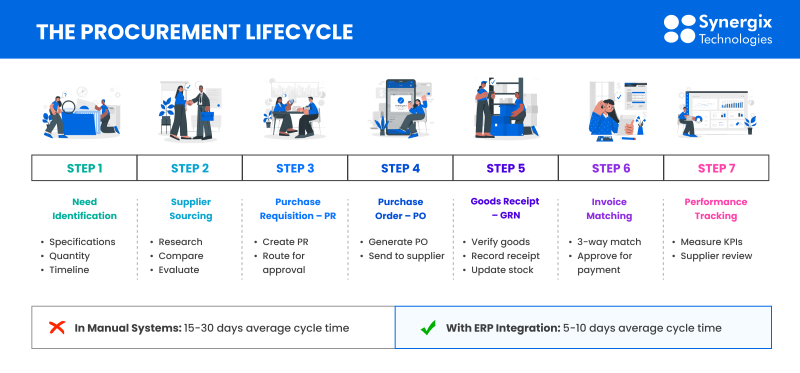
The knowledge of the procurement lifecycle will assist you in identifying the existence of bottlenecks and areas of improvement. The process of procurement works as follows:
Identifying Business Needs
It begins when any individual within your organisation discovers that he/she requires something be it raw materials to the production process, office supplies or even professional services. This requirement ought to be captured in form of specifications, quantity requirement, and timing.
Supplier Sourcing & Evaluation
This is followed by research on possible suppliers. This is in terms of matching of prices, references verification, quality standards, financial stability and terms and conditions. In the case of strategic purchases, you may post Request for Quotation (RFQ) or Request for Proposal (RFP) making this process formal.
Purchase Requisition Approval
Most businesses need to be internally approved before a purchase occurs. A purchase requisition is prepared by an employee and is passed through established approval procedures depending on the purchase value and availability of budget. This is a control measure that avoids unauthorised or unnecessary expenditure.
Purchase Order Creation
A purchase order is then created and submitted to the supplier upon approval. This is a legally binding document and your company is bound to the purchase and the price will be given in details, the quantity to be purchased, the delivery date and the payment terms.
Goods Receipt / Service Confirmation
Once the goods have been shipped or services rendered, there should be someone who checks to ensure that what is delivered corresponds to what he or she ordered. The next step becomes dependent on this goods receipt note (GRN) or service confirmation.
Invoice Matching & Payment
The supplier issues an invoice and this has to be reconciled with the purchase order and the receipt of goods. This triple match means that you will only pay what you ordered and that it was received. After confirmation, the invoice is to be paid based on agreed terms.
Performance Tracking & Reporting
The last one is to measure supplier performance and procurement data. Are the suppliers performing within time? Are costs trending up or down? In which areas are you spending most? This knowledge is fed into the decisions of future procurement.
In most SMEs, this seven step flow process is dispersed in emails, spreadsheets and paper files. In that lies great inefficiency.
Types of Procurement in Real Businesses
Not all procurement is the same. Understanding these categories helps you apply the right strategies:
Direct Procurement
This covers raw materials, components, and goods that directly become part of your products or services. For a furniture manufacturer, this means timber, hardware, and upholstery. For a restaurant, it’s food ingredients. Direct procurement directly affects product quality and production continuity, making supplier relationships critical.
Indirect Procurement
These are items and services that keep your business operating, but are not in your end product. Some of them are office supplies, computers, utilities, cleaning services, insurance, and marketing services. Though the amount of money spent in each individual purchase may not be big, indirect procurement can be a huge expenditure that may not be easily visible.
Services Procurement
This group entails outsourcing skills or labor, including consultants, contractors, in-temporary employees, IT services, or maintenance services. Services procurement needs varied evaluation criteria, unlike its physical counterpart where it is based more on expertise, track record, and deliverables and not on price only.
Project-Based Procurement
You require project-based procurement when you are doing particular projects such as renovating your office, replacing your software or even starting a marketing campaign. This is a time constrained type with clear scope and in most cases it is a simultaneous work of many vendors.
All types need dissimilar management strategies, though, all of them have systematic operations and combined systems.
Read more: Implementing E-Procurement: A Step-by-Step Guide
Common Procurement Challenges SMEs Face
Even those SMEs that are well-managed are faced with procurement issues that waste time and funds:
- Manual Approvals: Purchase requisition messages spread through email or paper cause delay, loss of accountability as well as audit trails. Budgets are not visible and requests become stranded or lost.
- Poor Visibility of Spend: When procurement information is stored in spreadsheets and in file cabinets, even simple queries such as how much did we spend with this supplier last quarter can be answered. or “What department is over budgeting? This shortsightedness does not allow making a strategic decision.
- Maverick Spending: When employees go around procurement and purchase directly with suppliers, it may sound convenient, only that it removes the bargaining power of prices, exposes the organisation to compliance risks, and makes it impossible to track expenses.
- Supplier Data Inconsistency: The supplier is entered in different systems (ABC Company, ABC Co., ABC Ltd.), and it is impossible to combine the spending data or manage the relations well.
- Lack of Integrity: There is no integration between your accounting software and your inventory management (and your procurement system) so you are always having a headache in terms of reconciliation. Purchase orders do not automatically update the records about inventory, and the processing of the invoices needs to be done manually and errors might occur during the process of the data entry.
It is more than a mere inconvenience. They express actual expenses in terms of ineffectiveness, lost discounts, order duplications, stock-outs and compliance risk.
How ERP Transforms Procurement for SMEs
Enterprise resource planning (ERP) system will bring all your business activities into one common platform. In the case of procurement, this is the transformative integration. The following are the ways that ERP bridges the gaps:
Centralised Vendor Master Data
Your ERP has one correct vendor database to which all people need to resort to. No further duplication and inconsistency of the information. Each supplier has a single record that consists of contact information, payment terms, price contracts, performance records, and compliance documents.
Automated Approval Workflows
The purchase requisitions will automatically be sent to the appropriate approved persons as per your rules. In case of purchase beyond some numbers more approvers are informed. Budget checks occur by default. The approvers are able to go and approve anywhere and the system has a full audit trail.
Three-Way Matching (PO, GRN, Invoice)
The ERP automatically compares the purchase orders, goods receipt notes and supplier invoices. In case all things are in agreement, the invoice is automatically passed on to payment. In the event of irregularities, they are indicated to be investigated by the system. This removes errors in payments and detects overcharge by suppliers.
Real-Time Spend Reporting
Since all procurement data is housed in a single system, you can have an immediate insight into patterns of spending. What are the departments that are over spending? What types are available in terms of savings? Which are the suppliers who should get more business? These questions can be answered by dashboards and reports without having to compile data manually.
Integration Across Functions
The actual magic is created when procurement becomes part of your whole operation. In case a purchase order is approved, inventory is updated automatically on the expected receipts. As goods are received and recognised, records are automatically generated. The cash flow reports are updated immediately invoices are paid. All things are in harmony with each other.
In the case of SMEs, such kind of integration was previously not available to small businesses. The current cloud ERP systems have now become cost-effective and feasible to large organisations as well as small enterprises.

Procurement Example Using an ERP System (Practical Scenario)
Let’s walk through a real scenario to see how ERP-enabled procurement works in practice.
Scenario: Your growing marketing agency needs to purchase 10 new laptops for incoming staff members.
- Step 1 – Need Identification: Your IT manager logs into the ERP system and creates a purchase requisition for 10 laptops, specifying the model, required delivery date, and attaching the IT equipment budget code.
- Step 2 – Automated Approval: The requisition automatically routes to the IT director for technical approval, then to the finance manager for budget approval. Each approver gets an email notification and can review and approve directly from their mobile device. The ERP shows real-time budget status, so the finance manager can see there’s sufficient budget allocated.
- Step 3 – Supplier Selection: Once approved, the purchasing team reviews preferred suppliers in the ERP’s vendor database. They see that Supplier A has provided good service previously with on-time deliveries and competitive pricing. They select this supplier.
- Step 4 – Purchase Order Generation: The ERP will automatically create a formal purchase order containing all the information on the requisition, and send it electronically to Supplier A, and consider it pending delivery within the system.
- Step 5 – Goods Receipt: On receipt of the laptops, the IT manager verifies them with the PO and documents a goods receipt in the ERP which confirms that the 10 laptops were received in good shape. Inventory records are updated immediately through the system.
- Step 6 – Invoice Processing: The supplier sends an email on his/her invoice which is keyed in the ERP. The system automatically does 3-way matching of the PO, the goods receipt and the invoice. All is even, hence the invoice is automatically placed on the payment queue based on the agreed 30 days payment terms.
- Step 7 – Payment & Reporting: The system creates payment proposal on the due date. Upon successful approval, payment is made and accrued. ERP automatically updates cash flow forecast, supplier payment history and spend reports.
According to the study conducted by the American Productivity and Quality Center, the requisition to order cycle time of the best performing organisations is only 5 hours as opposed to 48 hours in businesses with ineffective procurement operations, which is over eight times faster.
In the whole process, status became visible to everyone, no one was required to seek emails or paperwork and budget controls were automatically applied and all the data was recorded to be used in reporting and analysis. It is procurement by the book.
Key Procurement KPIs SMEs Should Track
It is impossible to measure what you do not measure. These procurement measures aid in the identification of opportunities and tracking performance:
- Purchase Cycle Time: How long does it take the need to the goods? Reduced cycle periods translate to an agile business. Monitor the average and identify bottlenecks that lead to delays.
- Cost Savings: Compare the actual purchase prices with the budget or past prices. Do you get deals that are much better? Do you bulk purchase with your suppliers? Measure the value that your procurement process adds.
- Supplier Performance: Track on-time delivery rates, quality defect rates and responsiveness of individual suppliers. This information will inform the decision on the suppliers that should be given more business and those that should be discussed or replaced.
- Spend By Category: See where your money Goes is eye-opening. When indirect procurement makes 40 percent of your total expenditure, then that area should be given strategic consideration and may need to be consolidated into few suppliers.
- Budget Variance: Do departments keep within budgets of procurement? High overruns mean either lack of planning or lack of controls. This measure assists in the control of organisational expenditures.
The new ERP systems automatically compute these KPIs thus providing you with real time dash boards that do not need to be manually compiled with data. This turns procurement to a fire repairing process to proactive process.
Why Synergix Technologies Is Built for SME Procurement
The increasing SMEs require procurement systems that are commensurate with their size and complexity, neither at enterprise cost nor complexity. This is the need of Synergix ERP.
The system will have a built-in procurement-to-payment processes that deliver the requisition, approval, ordering, receiving, and payment processes in a single process. Approval workflows can be configured to fit your company and spending policy without the need to be technical.
Financial visibility in real-time implies that you can continuously know your spending position and budgets as well as the payable amount to your suppliers. Synergix scales with your business, so as you expand your business by providing more users, more locations, and more complexity, you do not need to change your system.
To SMEs who are weary of procurement anarchy that spans emails, spreadsheets, and fragmented systems Synergix provides the integration and control that changes procurement into an administrative liability into a strategic asset.

Conclusion: Procurement as a Growth Enabler, Not Just a Cost Function
Procurement is much more than the act of purchasing. When done in a strategic manner, it is an effective tool of profitability, risk management, and competitive advantage. When dealing with the SMEs this disparity between the anarchic manual procurement and the methodical ERP-enacted procurement can spell the distinction between struggling cash flow and good margins.
The two most important lessons are obvious: procurement has a lifecycle, starting with the need identification, and managing the suppliers, and procurement takes up most of your business expenditures, and nowadays, with the help of modern technologies, world-class procurement is available to both large and small corporations.
When your procurement is linked to inventory, accounting and finance in an integrated ERP system, you will have the visibility, control, and efficiency that can not be matched in the manual processes. You can make better decisions quicker, you are able to remove errors and waste, and you establish supplier relationships that yield long-term value.
When the processes of procurement within your organisation are presently foreign and challenging to control, then it is time to consider how an integrated ERP solution can redefine this vital business process. Discover the benefits of Synergix ERP in enabling the SMEs to effectively deal with procurement and transform procurement into a growth-engine centre.